Configuring Neovim for Swift Development
Neovim is a modern reimplementation of Vim, a popular terminal-based text editor. Neovim adds new features like asynchronous operations and powerful Lua bindings for a snappy editing experience, in addition to the improvements Vim brings to the original Vi editor.
This article walks you through configuring Neovim for Swift development, providing configurations for various plugins to build a working Swift editing experience. The configuration files are built up step by step and the end of the article contains the fully assembled versions of those files. It is not a tutorial on how to use Neovim and assumes some familiarity with modal text editors like Neovim, Vim, or Vi. We are also assuming that you have already installed a Swift toolchain on your computer. If not, please see the Swift installation instructions.
Although the article references Ubuntu 22.04, the configuration itself works on any operating system where a recent version of Neovim and a Swift toolchain is available.
Basic setup and configuration includes:
- Installing Neovim.
- Installing
lazy.nvimto manage our plugins. - Configuring the SourceKit-LSP server.
- Setting up Language-Server-driven code completion with nvim-cmp.
- Setting up snippets with LuaSnip.
- Setting up the LLDB debugger.
The following sections are provided to help guide you through the setup:
- Prerequisites
- Package Management
- Language Server Support
- Code Completion
- Snippets
- Debugger Support
- Fully Assembled Configuration Files
Tip: If you already have Neovim, Swift, and a package manager installed, you can skip to setting up Language Server support.
Note: If you are bypassing the Prerequisites section, make sure your copy of Neovim is version v0.11 or higher, or you may experience issues with some of the Language Server Protocol (LSP) Lua APIs.
Prerequisites
To get started, you’ll need to install Neovim. The Lua APIs exposed by Neovim are under rapid development. We will want to take advantage of the recent improvements in the integrated support for Language Server Protocol (LSP), so we will need a fairly recent version of Neovim.
I’m running Ubuntu 22.04 on an x86_64 machine. Unfortunately, the
version of Neovim shipped in the Ubuntu 22.04 apt repository is too old to
support many of the APIs that we will be using.
For this install, I used snap to install Neovim v0.9.4.
Ubuntu 24.04 has a new enough version of Neovim, so a normal
apt install neovim invocation will work.
For installing Neovim on other operating systems and Linux distributions,
please see the
Neovim install page.
 $  sudo snap install nvim --classic
 $  nvim --version
NVIM v0.11.5
Build type: RelWithDebInfo
LuaJIT 2.1.1741730670
Run "nvim -V1 -v" for more info
Getting Started
We have working copies of Neovim and Swift on our path. While we can start with
a vimrc file, Neovim is transitioning from using vimscript to Lua. Lua
is easier to find documentation for since it’s an actual programming language,
tends to run faster, and pulls your configuration out of the main runloop so
your editor stays nice and snappy.
You can still use a vimrc with vimscript, but we’ll use Lua.
The main Neovim configuration file goes in ~/.config/nvim. The other Lua files
go in ~/.config/nvim/lua. Go ahead and create an init.lua now;
 $  mkdir -p ~/.config/nvim/lua && cd ~/.config/nvim
 $  nvim init.lua
Note: The examples below contain a GitHub link to the plugin to help you readily access the documentation. You can also explore the plugin itself.
Packaging with lazy.nvim
While it’s possible to set everything up manually, using a package manager helps keep your packages up-to-date, and ensures that everything is installed correctly when copy your configuration to a new computer. Neovim also has a built-in plugin manager, but I have found lazy.nvim to work well.
We will start with a little bootstrapping script to install lazy.nvim if it isn’t installed already, add it to our runtime path, and finally configure our packages.
At the top of your init.lua write:
local lazypath = vim.fn.stdpath("data") .. "/lazy/lazy.nvim"
if not (vim.uv or vim.loop).fs_stat(lazypath) then
    local lazyrepo = "https://github.com/folke/lazy.nvim.git"
    local out = vim.fn.system({ "git", "clone", "--filter=blob:none", "--branch=stable", lazyrepo, lazypath })
    if vim.v.shell_error ~= 0 then
        vim.api.nvim_echo({
            { "Failed to clone lazy.nvim:\n", "ErrorMsg" },
            { out, "WarningMsg" },
            { "\nPress any key to exit..." },
        }, true, {})
        vim.fn.getchar()
        os.exit(1)
    end
end
vim.opt.rtp:prepend(lazypath)
This snippet clones lazy.nvim if it doesn’t already exist, and then adds it to the runtime path. Now we initialize lazy.nvim and tell it where to look for the plugin specs.
require("lazy").setup("plugins")
NOTE: If you see the error ‘No specs found for module “plugins”’, This is expected since we haven’t added any plugins to the ‘lua/plugins’ directory yet.
This configures lazy.nvim to look in a plugins/ directory under our lua/
directory for each plugin. We’ll also want a place to put our own non-plugin
related configurations, so we’ll stick it in config/. Go ahead and create
those directories now.
$ mkdir lua/plugins lua/config
See lazy.nvim Configuration for details on configuring lazy.nvim.
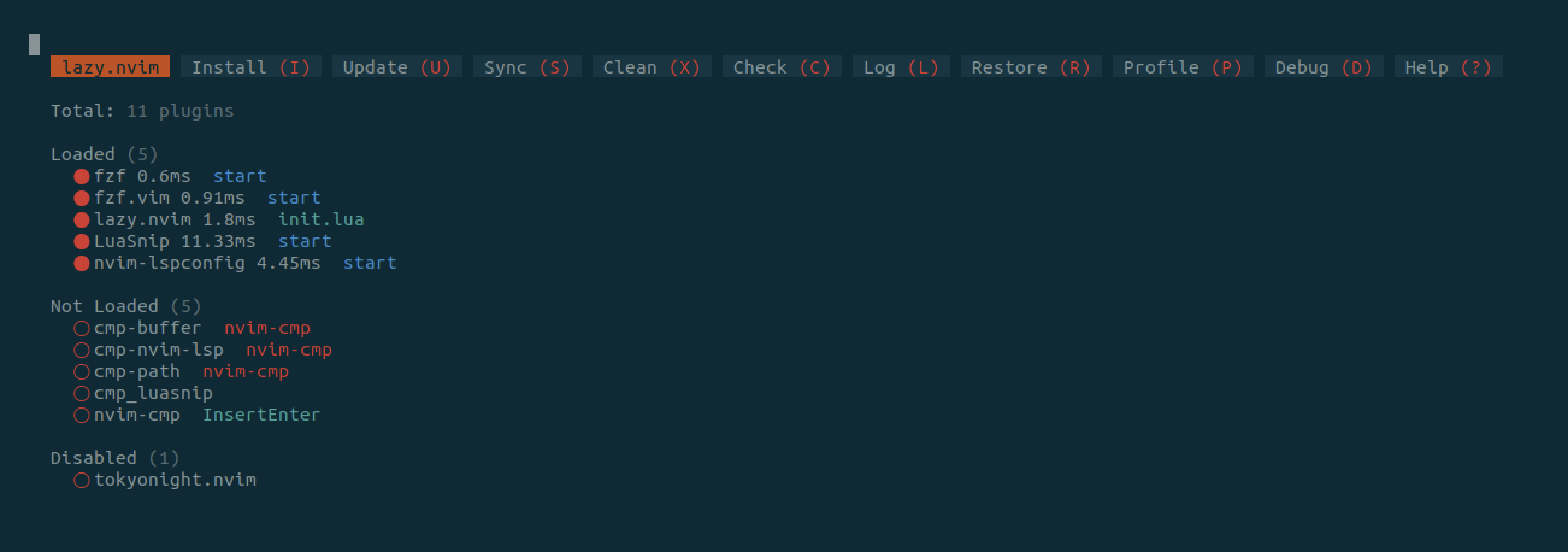
Note that your configuration won’t look exactly like this. We have only installed lazy.nvim, so that is the only plugin that is listed on your configuration at the moment. That’s not very exciting to look at, so I’ve added a few additional plugins to make it look more appealing.
To check that it’s working:
-
Launch Neovim.
You should first see an error saying that there were no specs found for module plugins. This just means that there aren’t any plugins.
-
Press Enter and type,
:Lazy.lazy.nvim lists the plugins installed. There should only be one right now: “lazy.nvim”. This is lazy.nvim tracking and updating itself.
-
We can manage our plugins through the lazy.nvim menu.
- Pressing
Iwill install new plugins. - Pressing
Uwill update installed plugins. - Pressing
Xwill delete any plugins that lazy.nvim installed, but are no longer tracked in your configuration.
- Pressing
Language Server Support
Language servers respond to editor requests providing language-specific support.
Neovim has support for Language Server Protocol (LSP) built-in.
Your configuration for each language server is installed to
<runtimepath>/lsp and enabled by calling vim.lsp.enable.
For more information run :help lsp and :help rtp in neovim.
Go ahead and create a new file under nvim/lsp/sourcekit.lua which is a runtimepath. In it, we’ll start by adding the following snippet.
-- lsp/sourcekit.lua
return {
  cmd = { 'sourcekit-lsp' },
  filetypes = { 'swift' },
  root_markers = {
    '.git',
    'compile_commands.json',
    '.sourcekit-lsp',
    'Package.swift',
  },
  get_language_id = function(_, ftype)
    return ftype
  end,
  capabilities = {
    workspace = {
      didChangeWatchedFiles = {
        dynamicRegistration = true,
      },
    },
    textDocument = {
      diagnostic = {
        dynamicRegistration = true,
        relatedDocumentSupport = true,
      },
    },
  },
}
This informs neovim we have a new language server called sourcekit but is not enabled by default.
The cmd field should be the path to sourcekit-lsp if it is not in your $PATH environment variable.
Adding a configuration for each LSP server manually is a lot of work. Neovim has a package for configuring LSP servers, nvim-lspconfig.
Create a new file in lua/config/lsp.lua to enable the sourcekit language server.
-- lua/config/lsp.lua
vim.lsp.enable("sourcekit")
Then import the configs in the init.lua file.
-- init.lua
require("config.lsp")
While this gives us LSP support through SourceKit-LSP, there are no keybindings, so it’s not very practical. Let’s hook those up now.
We’ll set up an auto command that fires when an LSP server attaches in the config
function under where we set up the sourcekit server. The keybindings are
applied to all LSP servers so you end up with a consistent experience across
languages.
-- lua/config/lsp.lua
vim.lsp.enable("sourcekit")

vim.api.nvim_create_autocmd('LspAttach', {
    desc = 'LSP Actions',
    callback = function(args)
        vim.keymap.set('n', 'K', vim.lsp.buf.hover, {noremap = true, silent = true})
        vim.keymap.set('n', 'gd', vim.lsp.buf.definition, {noremap = true, silent = true})
    end,
})
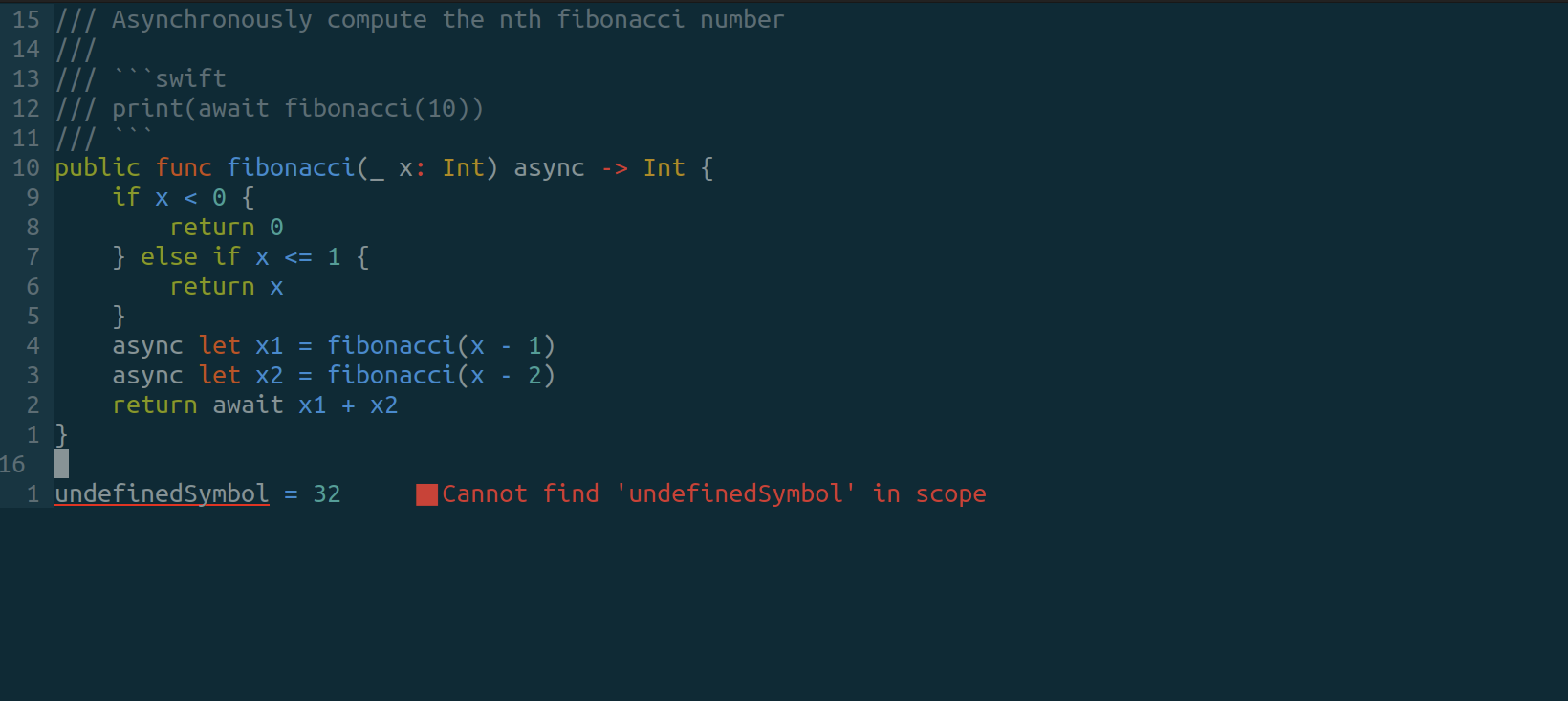
I’ve created a little example Swift package that computes Fibonacci
numbers asynchronously.
Pressing shift + k on one of the references to the fibonacci function
shows the documentation for that function, along with the function signature.
The LSP integration is also showing that we have an error in the code.
Code Completion
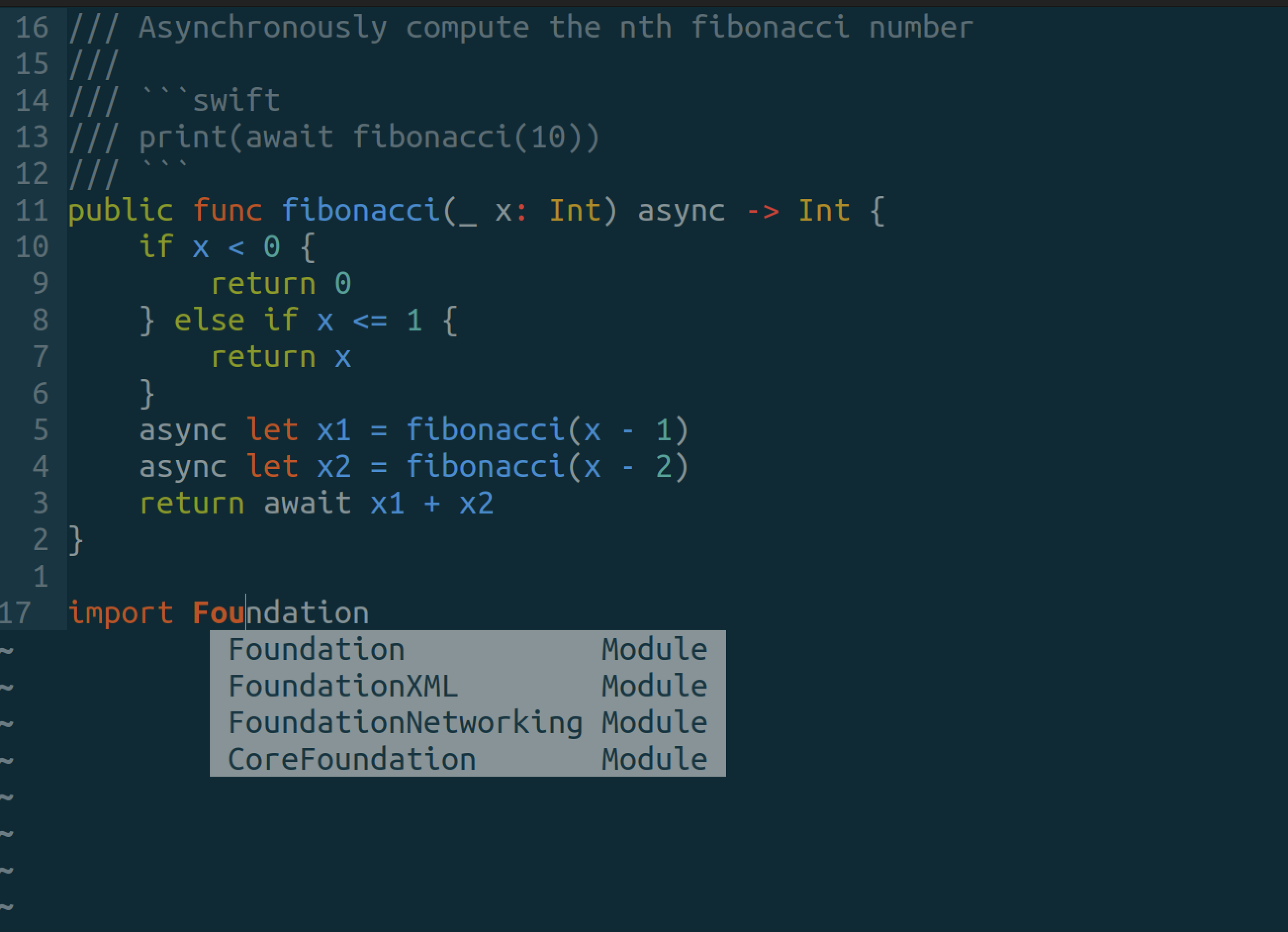
We will use nvim-cmp to act as the code completion mechanism. We’ll start by telling lazy.nvim to download the package and to load it lazily when we enter insert mode since you don’t need code completion if you’re not editing the file.
-- lua/plugins/codecompletion.lua
return {
    {
        "hrsh7th/nvim-cmp",
        version = false,
        event = "InsertEnter",
    },
}
Next, we’ll configure some completion sources to provide code completion results. nvim-cmp doesn’t come with completion sources, those are additional plugins. For this configuration, I want results based on LSP, filepath completion, and the text in my current buffer. For more, the nvim-cmp Wiki has a list of sources.
To start, we will tell lazy.nvim about the new plugins and that nvim-cmp depends on them. This ensures that lazy.nvim will initialize each of them when nvim-cmp is loaded.
-- lua/plugins/codecompletion.lua
return {
    {
        "hrsh7th/nvim-cmp",
        version = false,
        event = "InsertEnter",
        dependencies = {
            "hrsh7th/cmp-nvim-lsp",
            "hrsh7th/cmp-path",
            "hrsh7th/cmp-buffer",
        },
    },
    { "hrsh7th/cmp-nvim-lsp", lazy = true },
    { "hrsh7th/cmp-path", lazy = true },
    { "hrsh7th/cmp-buffer", lazy = true },
}
Now we need to configure nvim-cmp to take advantage of the code completion sources. Unlike many other plugins, nvim-cmp hides many of its inner-workings, so configuring it is a little different from other plugins. Specifically, you’ll notice the differences around setting key-bindings. We start out by requiring the module from within its own configuration function and will call the setup function explicitly.
return {
  {
    "hrsh7th/nvim-cmp",
    version = false,
    event = "InsertEnter",
    dependencies = {
      "hrsh7th/cmp-nvim-lsp",
      "hrsh7th/cmp-path",
      "hrsh7th/cmp-buffer",
    },
    config = function()
      local cmp = require('cmp')
      local opts = {
        -- Where to get completion results from
        sources = cmp.config.sources {
          { name = "nvim_lsp" },
          { name = "buffer"},
          { name = "path" },
        },
        -- Make 'enter' key select the completion
        mapping = cmp.mapping.preset.insert({
          ["<CR>"] = cmp.mapping.confirm({ select = true })
        }),
      }
      cmp.setup(opts)
    end,
  },
...
Using the tab key to select completions is a fairly popular option, so we’ll
go ahead and set that up now.
mapping = cmp.mapping.preset.insert({
    ["<CR>"] = cmp.mapping.confirm({ select = true }),
    ["<tab>"] = cmp.mapping(function(original)
        if cmp.visible() then
            cmp.select_next_item() -- run completion selection if completing
        else
            original()      -- run the original behavior if not completing
        end
    end, {"i", "s"}),
    ["<S-tab>"] = cmp.mapping(function(original)
        if cmp.visible() then
            cmp.select_prev_item()
        else
            original()
        end
    end, {"i", "s"}),
}),
Pressing tab while the completion menu is visible will select the next
completion and shift + tab will select the previous item. The tab behavior
falls back on whatever pre-defined behavior was there originally if the menu
isn’t visible.
Snippets
Snippets are a great way to improve your workflow by expanding short pieces of text into anything you like. Lets hook those up now. We’ll use LuaSnip as our snippet plugin.
Create a new file in your plugins directory for configuring the snippet plugin.
-- lua/plugins/snippets.lua
return {
    {
        'L3MON4D3/LuaSnip',
        config = function(opts)
            require('luasnip').setup(opts)
            require('luasnip.loaders.from_snipmate').load({ paths = "./snippets" })
        end,
    },
}
Now we’ll wire the snippet expansions into nvim-cmp. First, we’ll add LuaSnip as a dependency of nvim-cmp to ensure that it gets loaded before nvim-cmp. Then we’ll wire it into the tab key expansion behavior.
{
    "hrsh7th/nvim-cmp",
    version = false,
    event = "InsertEnter",
    dependencies = {
        "hrsh7th/cmp-nvim-lsp",
        "hrsh7th/cmp-path",
        "hrsh7th/cmp-buffer",
        "L3MON4D3/LuaSnip",
    },
    config = function()
        local cmp = require('cmp')
        local luasnip = require('cmp')
        local opts = {
            -- Where to get completion results from
            sources = cmp.config.sources {
                { name = "nvim_lsp" },
                { name = "buffer"},
                { name = "path" },
            },
            mapping = cmp.mapping.preset.insert({
                -- Make 'enter' key select the completion
                ["<CR>"] = cmp.mapping.confirm({ select = true }),
                -- Super-tab behavior
                ["<tab>"] = cmp.mapping(function(original)
                    if cmp.visible() then
                        cmp.select_next_item() -- run completion selection if completing
                    elseif luasnip.expand_or_jumpable() then
                        luasnip.expand_or_jump() -- expand snippets
                    else
                        original()      -- run the original behavior if not completing
                    end
                end, {"i", "s"}),
                ["<S-tab>"] = cmp.mapping(function(original)
                    if cmp.visible() then
                        cmp.select_prev_item()
                    elseif luasnip.expand_or_jumpable() then
                        luasnip.jump(-1)
                    else
                        original()
                    end
                end, {"i", "s"}),
            }),
            snippets = {
                expand = function(args)
                    luasnip.lsp_expand(args)
                end,
            },
        }
        cmp.setup(opts)
    end,
},
Now our tab-key is thoroughly overloaded in super-tab fashion.
- If the completion window is open, pressing tab selects the next item in the list.
- If you press tab over a snippet, the snippet will expand, and continuing to press tab moves the cursor to the next selection point.
- If you’re neither code completing nor expanding a snippet, it will behave
like a normal
tabkey.
Now we need to write up some snippets. LuaSnip supports several snippet formats, including a subset of the popular TextMate, Visual Studio Code snippet format, and its own Lua-based API.
Here are some snippets that I’ve found to be useful:
snippet pub "public access control"
  public $0

snippet priv "private access control"
  private $0

snippet if "if statement"
  if $1 {
    $2
  }$0

snippet ifl "if let"
  if let $1 = ${2:$1} {
    $3
  }$0

snippet ifcl "if case let"
  if case let $1 = ${2:$1} {
    $3
  }$0

snippet func "function declaration"
  func $1($2) $3{
    $0
  }

snippet funca "async function declaration"
  func $1($2) async $3{
    $0
  }

snippet guard
  guard $1 else {
    $2
  }$0

snippet guardl
  guard let $1 else {
    $2
  }$0

snippet main
  @main public struct ${1:App} {
    public static func main() {
      $2
    }
  }$0
Another popular snippet plugin worth mentioning is UltiSnips which allows you to use inline Python while defining the snippet, allowing you to write some very powerful snippets.
Debugger Support
Neovim does not natively support the Debug Adapter Protocol. To enable debugging, we rely on two plugins:
- nvim-dap for the protocol client implementation.
- nvim-dap-ui for the debug UI in neovim.
For the protocol server, we use lldb-dap which is bundled with the Swift toolchain.
Installation
Add both plugins to your configuration.
-- lua/plugins/debug.lua
local function find_lldb_dap()
  -- Will be implemented later.
end

return {
  {
    "mfussenegger/nvim-dap",
  },
  {
    "rcarriga/nvim-dap-ui",
    dependencies = { "mfussenegger/nvim-dap", "nvim-neotest/nvim-nio" },
  },
}
We need to configure three things before debugging works end-to-end:
- Register lldb-dap as a debug adapter.
- Define how Swift debug sessions are started.
- Setup the debug UI.
Register lldb-dap
We need to tell nvim-dap where to find the lldb-dap executable and how to launch it.
-- lua/plugins/debug.lua
local function find_lldb_dap()
  -- Will be implemented later.
end

return {
  {
    "mfussenegger/nvim-dap",
    config = function()
        -- Create the lldb-dap adapter.
        -- This tells the plugin where to find the lldb-dap executable and how to start it.
      local dap = require("dap")
      dap.adapters["lldb-dap"] = {
        type = "executable",
        name = "lldb-dap",
        command = find_lldb_dap(),
        options = {
          -- Uncomment and set a path to enable lldb-dap logging (useful for bug reports).
          -- env = { LLDBDAP_LOG = "/path/to/store/lldb-dap.log" },
        },
      }
    end,
  }
Let’s fill in the find_lldb_dap helper at the top of the file. It first tries to locate the binary via
xcrun, then falls back to whatever is in your ${PATH}.
-- lua/plugins/debug.lua
local function find_lldb_dap()
  -- If you know the path to the lldb-dap binary change the line below.
  -- return "/path/to/lldb-dap"

  -- macOS: Try lldb-dap with xcrun.
  local xcrun_result = vim.system({ "xcrun", "--find", "lldb-dap" }, { text = true }):wait()
  if xcrun_result.code == 0 then
    local xcrun_dap_path = vim.fn.trim(xcrun_result.stdout)
    if vim.fn.executable(xcrun_dap_path) then
      return xcrun_dap_path
    end
  end

  -- Fallback the lldb-dap in the ${PATH} environment.
  if vim.fn.executable("lldb-dap") == 1 then
    return "lldb-dap"
  end

  vim.notify("lldb-dap not found, add it to your ${PATH}", vim.log.levels.WARN)
  return ""
end

return {
  {
    "mfussenegger/nvim-dap",
    ...
}
Warning: The lldb-dap binary from the LLVM repository or Linux package managers is most likely not built with Swift support and will be unable to debug Swift binaries. Use the version bundled with the Swift toolchain instead.
Add Swift Debug Session Configurations.
With the adapter registered, we can define how debug sessions are started. The three configurations below cover the most common workflows: Launching a program, Launching with arguments, and Attaching to a running process. You can add more configurations if needed by your workflow.
-- lua/plugins/debug.lua
local function find_lldb_dap()
  ...
end

return {
  ...
      dap.adapters["lldb-dap"] = {
        ...
      },

      -- Add lldb-dap configurations.
      dap.configurations.swift = {
        {
          name = "Launch program",
          type = "lldb-dap",
          request = "launch",
          program = function()
            return require("dap.utils").pick_file({ executables = true })
          end,
          cwd = "${workspaceFolder}",
        },
        {
          name = "Launch program with arguments",
          type = "lldb-dap",
          request = "launch",
          program = function()
            return require("dap.utils").pick_file({ executables = true })
          end,
          cwd = "${workspaceFolder}",
          args = function()
            local args_str = vim.fn.input("Arguments: ")
            return require("dap.utils").splitstr(args_str)
          end,
        },
        {
          name = "Attach to program",
          type = "lldb-dap",
          request = "attach",
          pid = function()
            return require("dap.utils").pick_process()
          end,
        },
      }
  ...
}
NOTE: nvim-dap plugin supports additional variables such as
${file}and${workspaceFolder}inside configurations. Run:help dap-configurationsin Neovim for the full list.
NOTE: lldb-dap supports additional options such as
envandinitCommands. See lldb-dap’s configuration reference for the full list.
Setup The Debug UI.
Automatically show and hide UI panes.
By default, running :DapContinue shows no debug panes.
Hook into the DAP session lifecycle to open the UI when a session starts and close it when it ends.
-- lua/plugins/debug.lua
local function find_lldb_dap()
  ...
end

return {
  ...
  {
    "rcarriga/nvim-dap-ui",
    dependencies = { "mfussenegger/nvim-dap", "nvim-neotest/nvim-nio" },
    config = function(_, opts)
      local dap = require("dap")
      local dapui = require("dapui")
      dapui.setup(opts)
      dap.listeners.after.event_initialized["dapui_config"] = function()
        dapui.open({})
      end
      dap.listeners.before.event_terminated["dapui_config"] = function()
        dapui.close({})
      end
      dap.listeners.before.event_exited["dapui_config"] = function()
        dapui.close({})
      end
    end
  },
}
Highlight the current stopped line
Add a sign and highlight group so it is always clear where execution has paused.
--- lua/plugins/debug.lua
    ...
    "mfussenegger/nvim-dap",
    config = function()
      -- highlight the current stopped line
      vim.api.nvim_set_hl(0, "DapStopped", { default = true, link = "Visual" })
      vim.fn.sign_define('DapStopped', { linehl = 'DapStopped' })
    ...
Keymaps
Let’s add keyboard shortcuts for debug sessions. Feel free to change the values to your preferred shortcuts.
--- lua/plugins/debug.lua
local function find_lldb_dap()
  ...
end

return {
  {
    "mfussenegger/nvim-dap",
    config = function()
      ...
    end,
    keys = {
      { "<leader>dB", function() require("dap").set_breakpoint(vim.fn.input('Breakpoint condition: ')) end, desc = "Breakpoint Condition" },
      { "<leader>db", function() require("dap").toggle_breakpoint() end, desc = "Toggle Breakpoint" },
      { "<leader>dc", function() require("dap").continue() end, desc = "Run/Continue" },
      { "<leader>dC", function() require("dap").run_to_cursor() end, desc = "Run to Cursor" },
      { "<leader>dg", function() require("dap").goto_() end, desc = "Go to Line (No Execute)" },
      { "<leader>di", function() require("dap").step_into() end, desc = "Step Into" },
      { "<leader>dj", function() require("dap").down() end, desc = "Go Down a Frame" },
      { "<leader>dk", function() require("dap").up() end, desc = "Go Up a Frame" },
      { "<leader>dO", function() require("dap").step_out() end, desc = "Step Out" },
      { "<leader>do", function() require("dap").step_over() end, desc = "Step Over" },
      { "<leader>dP", function() require("dap").pause() end, desc = "Pause" },
      { "<leader>dr", function() require("dap").repl.toggle() end, desc = "Toggle REPL" },
      { "<leader>ds", function() require("dap").session() end, desc = "Session" },
      { "<leader>dt", function() require("dap").terminate() end, desc = "Terminate" },
      { "<leader>dh", function() require("dap.ui.widgets").hover() end, desc = "Widgets" },
    },
  }
...
Start a debug session with <leader>dc or :DapContinue. After selecting a configuration,
you should have a working debug session. Similar to the screenshot below.
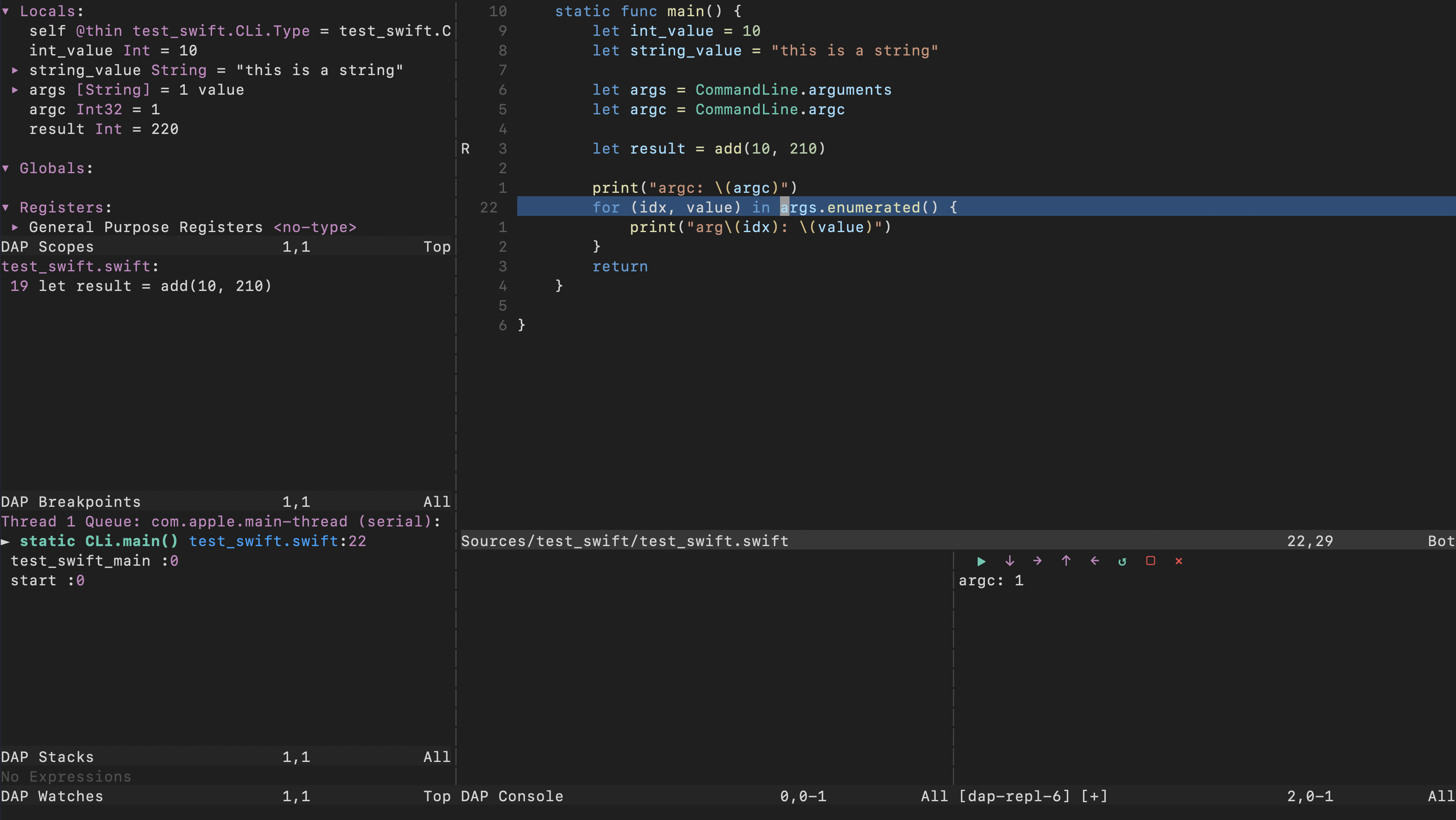
If you see [?] instead of button icons, your font does not support
codicons,
which nvim-dap uses by default. Replace them with plain Unicode characters by
add the the following snippet to the config.
-- debug/plugins/debug.lua
  ...
  {
    "rcarriga/nvim-dap-ui",
    dependencies = { "mfussenegger/nvim-dap", "nvim-neotest/nvim-nio" },
    config = function(_, opts)
      local dap = require("dap")
      local dapui = require("dapui")
      local new_opts = opts
      new_opts = vim.tbl_deep_extend("keep", new_opts, {
        icons = {
          expanded = "▾",
          collapsed = "▸",
          current_frame = "►",
        },
        controls = {
          icons = {
            pause = "⏸",
            play = "▶",
            step_into = "↓",
            step_over = "→",
            step_out = "↑",
            step_back = "←",
            run_last = "↺",
            terminate = "□",
            disconnect = "×",
          },
        },
      })
    ...
    end
  ...
Conclusion
Swift development with Neovim is a solid experience once everything is configured correctly. There are thousands of plugins for you to explore, this article gives you a solid foundation for building up your Swift development experience in Neovim.
Files
Here are the files for this configuration in their final form.
-- init.lua
local lazypath = vim.fn.stdpath("data") .. "/lazy/lazy.nvim"
if not (vim.uv or vim.loop).fs_stat(lazypath) then
  local lazyrepo = "https://github.com/folke/lazy.nvim.git"
  local out = vim.fn.system({ "git", "clone", "--filter=blob:none", "--branch=stable", lazyrepo, lazypath })
  if vim.v.shell_error ~= 0 then
    vim.api.nvim_echo({
      { "Failed to clone lazy.nvim:\n", "ErrorMsg" },
      { out, "WarningMsg" },
      { "\nPress any key to exit..." },
    }, true, {})
    vim.fn.getchar()
    os.exit(1)
  end
end
vim.opt.rtp:prepend(lazypath)
require("lazy").setup("plugins", {
  ui = {
    icons = {
      cmd = "",
      config = "",
      event = "",
      ft = "",
      init = "",
      keys = "",
      plugin = "",
      runtime = "",
      require = "",
      source = "",
      start = "",
      task = "",
      lazy = "",
    },
  },
})
require("config.lsp")

vim.opt.wildmenu = true
vim.opt.wildmode = "list:longest,list:full" -- don't insert, show options

-- line numbers
vim.opt.nu = true
vim.opt.rnu = true

-- textwrap at 80 cols
vim.opt.tw = 80

-- set solarized colorscheme.
-- NOTE: Uncomment this if you have installed solarized, otherwise you'll see
--       errors.
-- vim.cmd.background = "dark"
-- vim.cmd.colorscheme("solarized")
-- vim.api.nvim_set_hl(0, "NormalFloat", { bg = "none" })
-- lua/plugins/codecompletion.lua
return {
  {
    "hrsh7th/nvim-cmp",
    version = false,
    event = "InsertEnter",
    dependencies = {
      "hrsh7th/cmp-nvim-lsp",
      "hrsh7th/cmp-path",
      "hrsh7th/cmp-buffer",
    },
    config = function()
      local cmp = require('cmp')
      local luasnip = require('luasnip')
      local opts = {
        sources = cmp.config.sources {
          { name = "nvim_lsp", },
          { name = "path", },
          { name = "buffer", },
        },
        mapping = cmp.mapping.preset.insert({
          ["<CR>"] = cmp.mapping.confirm({ select = true }),
          ["<tab>"] = cmp.mapping(function(original)
            print("tab pressed")
            if cmp.visible() then
              print("cmp expand")
              cmp.select_next_item()
            elseif luasnip.expand_or_jumpable() then
              print("snippet expand")
              luasnip.expand_or_jump()
            else
              print("fallback")
              original()
            end
          end, {"i", "s"}),
          ["<S-tab>"] = cmp.mapping(function(original)
            if cmp.visible() then
              cmp.select_prev_item()
            elseif luasnip.expand_or_jumpable() then
              luasnip.jump(-1)
            else
              original()
            end
          end, {"i", "s"}),

        })
      }
      cmp.setup(opts)
    end,
  },
  { "hrsh7th/cmp-nvim-lsp", lazy = true },
  { "hrsh7th/cmp-path", lazy = true },
  { "hrsh7th/cmp-buffer", lazy = true },
}
-- lsp/sourcekit.lua
return {
  cmd = { 'sourcekit-lsp' },
  filetypes = { 'swift' },
  root_markers = {
    '.git',
    'compile_commands.json',
    '.sourcekit-lsp',
    'Package.swift',
  },
  get_language_id = function(_, ftype)
    return ftype
  end,
  capabilities = {
    workspace = {
      didChangeWatchedFiles = {
        dynamicRegistration = true,
      },
    },
    textDocument = {
      diagnostic = {
        dynamicRegistration = true,
        relatedDocumentSupport = true,
      },
    },
  },
}
-- lua/config/lsp.lua
vim.lsp.enable("sourcekit")

vim.api.nvim_create_autocmd('LspAttach', {
  desc = "LSP Actions",
  callback = function(args)
    vim.keymap.set("n", "K", vim.lsp.buf.hover, {noremap = true, silent = true})
    vim.keymap.set("n", "gd", vim.lsp.buf.definition, {noremap = true, silent = true})
  end,
})
}
-- lua/plugins/snippets.lua
return {
  {
    'L3MON4D3/LuaSnip',
    lazy = false,
    config = function(opts)
      local luasnip = require('luasnip')
      luasnip.setup(opts)
      require('luasnip.loaders.from_snipmate').load({ paths = "./snippets"})
    end,
  }
}
# snippets/swift.snippets

snippet pub "public access control"
  public $0

snippet priv "private access control"
  private $0

snippet if "if statement"
  if $1 {
    $2
  }$0

snippet ifl "if let"
  if let $1 = ${2:$1} {
    $3
  }$0

snippet ifcl "if case let"
  if case let $1 = ${2:$1} {
    $3
  }$0

snippet func "function declaration"
  func $1($2) $3{
    $0
  }

snippet funca "async function declaration"
  func $1($2) async $3{
    $0
  }

snippet guard
  guard $1 else {
    $2
  }$0

snippet guardl
  guard let $1 else {
    $2
  }$0

snippet main
  @main public struct ${1:App} {
    public static func main() {
      $2
    }
  }$0
-- lua/plugins/debug.lua
local function find_lldb_dap()
  -- If you know the path to the lldb-dap change the line
  -- return "/path/to/lldb-dap"

  -- macOS: Try lldb-dap with xcrun.
  local xcrun_result = vim.system({ "xcrun", "--find", "lldb-dap" }, { text = true }):wait()
  if xcrun_result.code == 0 then
    local xcrun_dap_path = vim.fn.trim(xcrun_result.stdout)
    if vim.fn.executable(xcrun_dap_path) then
      return xcrun_dap_path
    end
  end

  -- Fallback the lldb-dap in the ${PATH} environment.
  if vim.fn.executable("lldb-dap") == 1 then
    return "lldb-dap"
  end

  vim.notify("lldb-dap not found, add it to your PATH environment variable", vim.log.levels.WARN)
  return ""
end

return {
  {
    "mfussenegger/nvim-dap",
    config = function()
      -- highlight the current stopped line
      vim.api.nvim_set_hl(0, "DapStopped", { default = true, link = "Visual" })
      vim.fn.sign_define('DapStopped', { linehl = 'DapStopped' })
      -- Create the lldb-dap adapter
      -- This tells the plugin where to find the lldb-dap executable and how to start it.
      local dap = require("dap")
      dap.adapters["lldb-dap"] = {
        type = "executable",
        name = "lldb-dap",
        command = find_lldb_dap(),
        options = {
          -- Uncomment and set a path to enable lldb-dap logging (useful for bug reports).
          -- env = { LLDBDAP_LOG = "/path/to/store/lldb-dap.log" },
        },
      }

      -- Add a new configuration
      -- We pass the information to lldb-dap when we launch the debugger
      -- this tells lldb-dap how to launch our program
      dap.configurations.swift = {
        {
          name = "Launch",
          type = "lldb-dap",
          request = "launch",
          program = function()
            return require("dap.utils").pick_file({ executables = true })
          end,
          cwd = "${workspaceFolder}",
        },
        {
          name = "Launch with arguments",
          type = "lldb-dap",
          request = "launch",
          program = function()
            return require("dap.utils").pick_file({ executables = true })
          end,
          cwd = "${workspaceFolder}",
          args = function()
            local args_str = vim.fn.input("Arguments: ")
            return require("dap.utils").splitstr(args_str)
          end,
        },
        {
          name = "Attach",
          type = "lldb-dap",
          request = "attach",
          pid = function()
            return require("dap.utils").pick_process()
          end,
        },

      }
    end,
    keys = {
      { "<leader>dB", function() require("dap").set_breakpoint(vim.fn.input('Breakpoint condition: ')) end, desc = "Breakpoint Condition" },
      { "<leader>db", function() require("dap").toggle_breakpoint() end, desc = "Toggle Breakpoint" },
      { "<leader>dc", function() require("dap").continue() end, desc = "Run/Continue" },
      { "<leader>dC", function() require("dap").run_to_cursor() end, desc = "Run to Cursor" },
      { "<leader>dg", function() require("dap").goto_() end, desc = "Go to Line (No Execute)" },
      { "<leader>di", function() require("dap").step_into() end, desc = "Step Into" },
      { "<leader>dj", function() require("dap").down() end, desc = "Go Down a Frame" },
      { "<leader>dk", function() require("dap").up() end, desc = "Go Up a Frame" },
      { "<leader>dO", function() require("dap").step_out() end, desc = "Step Out" },
      { "<leader>do", function() require("dap").step_over() end, desc = "Step Over" },
      { "<leader>dP", function() require("dap").pause() end, desc = "Pause" },
      { "<leader>dr", function() require("dap").repl.toggle() end, desc = "Toggle REPL" },
      { "<leader>ds", function() require("dap").session() end, desc = "Session" },
      { "<leader>dt", function() require("dap").terminate() end, desc = "Terminate" },
      { "<leader>dh", function() require("dap.ui.widgets").hover() end, desc = "Widgets" },
    },
  },
  {
    "rcarriga/nvim-dap-ui",
    dependencies = { "mfussenegger/nvim-dap", "nvim-neotest/nvim-nio" },
    config = function(_, opts)
      local dap = require("dap")
      local dapui = require("dapui")
      local new_opts = opts
      -- Remove if your font does supports codicons.
      new_opts = vim.tbl_deep_extend("keep", new_opts, {
        icons = {
          expanded = "▾",
          collapsed = "▸",
          current_frame = "►",
        },
        controls = {
          icons = {
            pause = "⏸",
            play = "▶",
            step_into = "↓",
            step_over = "→",
            step_out = "↑",
            step_back = "←",
            run_last = "↺",
            terminate = "□",
            disconnect = "×",
          },
        },
      })
      dapui.setup(new_opts)
      dap.listeners.after.event_initialized["dapui_config"] = function()
        dapui.open({})
      end
      dap.listeners.before.event_terminated["dapui_config"] = function()
        dapui.close({})
      end
      dap.listeners.before.event_exited["dapui_config"] = function()
        dapui.close({})
      end
    end
  },
}